What happens when neighbours disagree over property boundaries?
.webp)
Summary
Boundary disputes in England and Wales usually start from a misunderstanding of where the legal line sits — and a Land Registry title plan does not settle it, because the red line shows only the 'general boundary', not the precise legal one. This article identifies the three common triggers (new fences or extensions, overhanging trees and hedges, and surveys ordered during a sale) and the four evidence types used to establish the true boundary: the original conveyance or transfer deed, long-standing features such as walls and ditches, historical photographs and witness statements, and a chartered land surveyor's expert report. It distinguishes a boundary from a right of way, explains that a Party Wall Act notice is not itself a boundary dispute, and warns that ongoing neighbour disputes must be disclosed on the TA6 when selling — so leaving it for the next owner risks a misrepresentation claim.
Disputes over property boundaries are among the most common legal issues faced by homeowners – and often among the most frustrating and stressful. What might start out as a simple disagreement over the placement of a wall or a tree overhanging a garden fence can quickly escalate into a long-running conflict.
And it’s not just your peace of mind that can be affected. UK law requires you to disclose any ongoing disputes with neighbours, which can make it difficult to sell or drive down the market value of your home.
What are the main causes of boundary disputes?
Most boundary disputes arise from a simple misunderstanding of where the property line legally lies. While a fence or wall might seem like an obvious marker, the legal boundary is an invisible line that must be determined by evidence. The most common triggers for a dispute include:
New construction
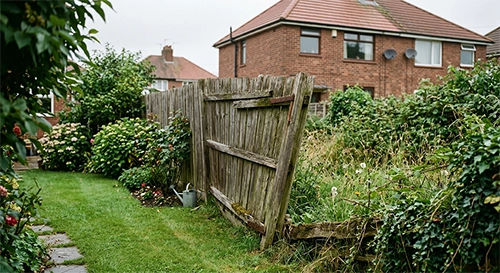
A neighbour puts up a new fence, builds an extension to their home or changes the position of a boundary wall – and you believe that it encroaches onto your property.
Hedges or trees
When branches overhang a property boundary or leaves fall into a neighbouring property, disputes can arise over who has the right to prune or trim plants and who is responsible for disposing of leaf litter, based on where the true boundary lies.
Selling a property
Boundary disputes often occur when a property owner is selling and a potential buyer orders a survey. If the survey reveals differences between the physical boundaries of the property – the locations of fences, walls or hedges – and what is recorded in the title deeds, this can trigger a dispute (and put the sale at risk until it is resolved).
What proves the true location of a property boundary?
To resolve a boundary dispute, mediators or courts will examine various types of evidence to establish where the true boundary between two properties lies. These include:
The original conveyance or transfer deed – this is the legal document that first divided the land. It may contain a more detailed description or plan than the Land Registry, which can help to resolve disagreements about where the boundary lies.
Historical physical features: Long-standing features such as walls, ditches or hedges can provide strong evidence about the original position of the boundary.
Supporting evidence: Old photographs, witness statements from previous owners, and evidence of how the land has been used over the years can all help to build a complete picture.
Expert reports: If the location of the boundary is still not clear, a chartered land surveyor specialising in boundary disputes can be instructed to review the evidence and provide an expert opinion on the position of the boundary.
A quiet word is better than a court order
When neighbours find themselves in a dispute over a property boundary, it’s better for all involved if the matter can be settled amicably without involving the courts. A friendly conversation should always be the starting point – and in many cases, the issue can be resolved without further action.
Going to court is a last resort, but it may be the only way to obtain a definitive ruling over where the boundary lies. If you’re involved in a property boundary dispute, contact Complex Law – we’ll help you plan the most effective approach to resolve your disagreement – and protect your property rights.
Frequently asked questions
My neighbour has sent me a Party Wall Act notice. Is this a boundary dispute?
No, although it is related. A Party Wall Act notice applies when someone is carrying out building work on or near a shared wall (a 'party wall'). The purpose of the notice is to inform you that the work is happening, and allow you to appoint a surveyor, if you wish, to ensure that there is no damage to your property as a result. However, building work affecting party walls can sometimes trigger boundary disputes if one owner believes the work encroaches on their property.
What is the difference between a boundary and a right-of-way?
A boundary is a line dividing two properties. A right-of-way (also known as an easement) is a legal right to cross property that you do not own for a specific purpose. For example, you may have the right of way to drive over a neighbour's driveway in order to park your car in your garage (the specific purpose), but that does not give you the right to park your car on the driveway itself.
The Land Registry plan seems clear, so why is there still a dispute?
The red line on a Land Registry title plan shows the "general boundary" only – not the precise legal boundary. So, even when Land Registry plans look straightforward, two neighbours may still have a legitimate disagreement over the exact position of the boundary, or whether there is an encroachment. The law states that the legal boundary must be determined by examining the deeds, the land's physical features, and other evidence.
Can I just sell my house and let the new owner deal with it?
No. When you sell a property, you are legally required to disclose any ongoing disputes with neighbours on the Seller's Property Information Form (TA6). Failing to do so can lead to the buyer suing you for misrepresentation later. An unresolved boundary dispute can make a property difficult to sell or reduce its value, which is why it's always better to resolve it first.



.svg)