.svg)


%201.svg)
%201.svg)


.svg)
13/8/2026

8
Min
.webp)
David Whelan
Section 8 possession claims explained
In this guide, property law expert David Whelan explains how Section 8 possession claims work now that they are the sole legal route to possession, covering the grounds available, notice periods, the court process, and the steps landlords and tenants should take at each stage.
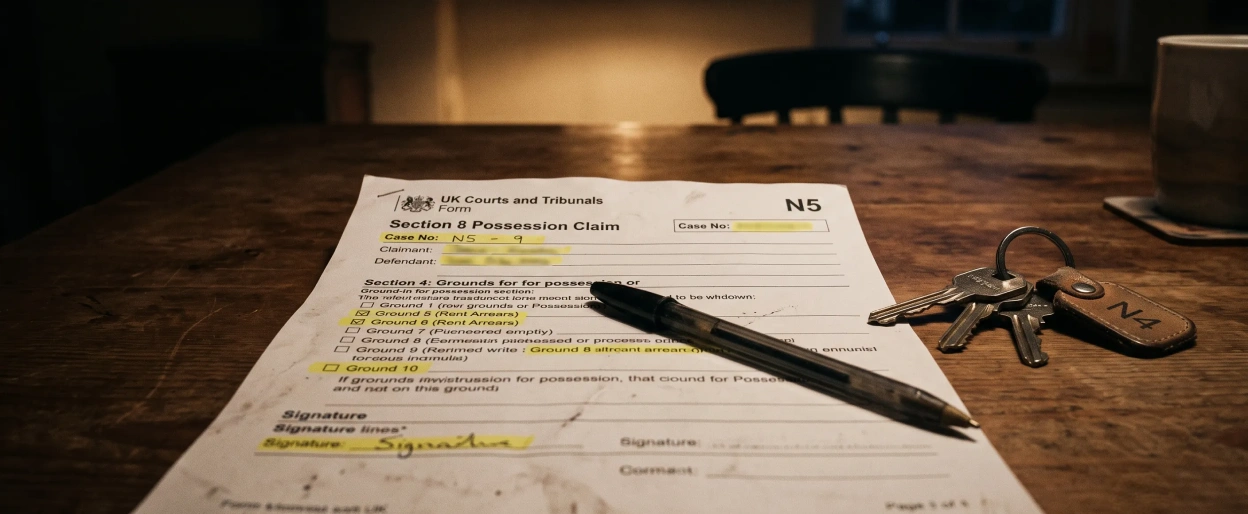
Since "no-fault" evictions were abolished under the Renters Rights Act 2025, Section 8 has become the only legal route available to landlords in England seeking possession of a rented property. In this guide, our property law specialist David Whelan explains how the process works, the grounds available, and what both landlords and tenants should do to protect their position.
What is Section 8, and why does it matter?
Prior to 1 May 2026, landlords were able to seek possession of a property they own without the need to prove a valid reason: a process known as “no fault eviction” or, officially, serving a Section 21 notice. Now, with Section 21 abolished, the only legal avenue for landlords looking to gain possession of a property is by serving notice under Section 8 of the Housing Act 1988.
A landlord using Section 8 must state a valid legal ground, and in many cases, must be prepared to prove it in court if the tenant disputes the claim. This makes accuracy and evidence essential. A notice that cites the wrong ground, uses the incorrect form, or gives an insufficient notice period can be invalidated, forcing the landlord to start the process again from the beginning.
What are the main grounds for possession?
Grounds for possession fall into two categories.
Mandatory grounds – if the landlord proves the ground, the court must grant possession. There is no discretion, regardless of the tenant's personal circumstances.
Discretionary grounds – even where the ground is proven, the court will only grant possession if it considers that possession would be a reasonable outcome. The court will consider additional information, such as the tenant's circumstances, how serious the breach of the tenancy agreement was, and any mitigating factors.
The most common grounds we encounter when representing landlords or tenants include:
- Ground 8 (Mandatory) – At least three months' rent unpaid at notice and hearing dates
- Ground 10 (Discretionary) – Some rent arrears (below the Ground 8 threshold)
- Ground 11 (Discretionary) – Persistent late payment of rent
- Ground 12 (Discretionary) – Breach of a term of the tenancy agreement
- Ground 13 (Discretionary) – Deterioration of the property due to the tenant's conduct
- Ground 14 (Discretionary) – Nuisance, annoyance, or illegal/immoral use of the property
What notice periods apply to Section 8 notices?
There’s no standard notice period for Section 8 notices; it varies according to the specific grounds the notice relies on. Generally speaking, cases involving tenant misconduct have shorter notice periods, so, for example, Ground 8, which relates to serious rent arrears, can be served with 4 weeks' notice. Ground 14, which relates to antisocial behaviour, nuisance or illegal use of the property, has no minimum notice period. In serious cases, a landlord may be granted possession immediately after serving the notice.
Where there is no issue with tenant conduct, notice periods may be longer. A good example is Ground 1A, which a landlord may use to obtain possession to sell a property. This requires a notice period of 4 months, and cannot be used during the first year of a new tenancy.
What happens after the notice period expires?
Once the notice period expires, and if the tenant has not either vacated the property or resolved the issue (for example, paying outstanding rent), the landlord can issue a claim for possession in the County Court. The court may grant an outright possession order, a suspended or conditional order, or dismiss the claim.
What makes a Section 8 notice valid?
For a Section 8 notice to be valid and enforceable, it must fulfil the criteria below. If any of these elements are missing or incorrect, a tenant may be able to successfully challenge the notice, and the landlord may need to start the process again.
- Be served using the correct prescribed form (usually Form 3)
- Clearly and fully state the ground or grounds relied upon
- Set out the facts and reasons supporting each ground
- Give the correct minimum notice period for the ground(s) used
- Be served on the correct tenant(s), at the correct address
What can landlords do to strengthen their position?
If you’re a landlord considering issuing a Section 8 notice, the best way to ensure you’re in a strong position is to be meticulous in your preparations.
First, check that you’re complying with all of the legal obligations you have as a landlord. Compliance gaps such as mishandling tenants’ deposits, failing to provide prescribed information at the start of the tenancy or missing safety certificates can potentially invalidate any notice you serve.
Then, check that your notice is compliant. Are you using the correct and current version of the prescribed form (usually Form 3)? Have you given the correct notice period according to the ground(s) your notice relies on? Are all of the details on the form – names, addresses, grounds – correct?
Finally, ensure you have sufficient evidence to prove the grounds you are relying on in the notice. Keep clear, dated records of rent payments, correspondence, and any breaches relied upon. Collect witness statements where applicable. Gather photo or video evidence if seeking to prove damage or nuisance.
What can tenants raise as a defence against a Section 8 notice?
If you’re a tenant and you’ve received a Section 8 notice, you may not have to vacate the property if the notice is invalid, or if there is insufficient evidence to prove the grounds that the notice relies on. Most often, tenants’ defences rely on one of the following:
- Procedural errors – the wrong form was used, the notice period was incorrect, or the notice failed to properly state the ground relied upon.
- Disputed facts – for example, disputing the amount of arrears claimed, or denying that a breach occurred.
- Compliance failures – if the landlord failed to protect the tenant's deposit correctly, or failed to provide required documentation, this may affect the court's decision on some claims.
- Disrepair counterclaims – where a tenant raises unresolved disrepair as a counterclaim, this can reduce any arrears award and, in some cases, affect the outcome of the possession claim itself.
Dealing with a Section 8 notice as a landlord or tenant?
The legal process surrounding possession claims under Section 8 is complex and technical, and in many cases timeframes and deadlines are short. It’s therefore beneficial for either party – landlord or tenant – involved in a possession claim to seek qualified legal advice as soon as possible.
Early advice can help you avoid procedural errors, strengthen your evidence, and in many cases, help resolve the matter without the need for a court hearing. If you’re planning to serve a Section 8 notice, or you have received one from your landlord, speak to Complex Law for clear, plain-English advice on the best way forward.
Quick Quiz
How much did you learn about this topic?
Quiz: Question 1 of
5
Quiz Complete
You scored X out of
5











.svg)