.svg)


%201.svg)
%201.svg)


.svg)
23/3/2026

7
Min
Breach of Contract
Contracts are a part of daily life – from accepting terms and conditions online to hiring a builder, painter or wedding photographer. But what about when someone doesn't hold up their end of the deal? This guide will walk you through what counts as a breach of contract, what your rights are, and the steps you can take to resolve the situation.
What makes a contract valid?
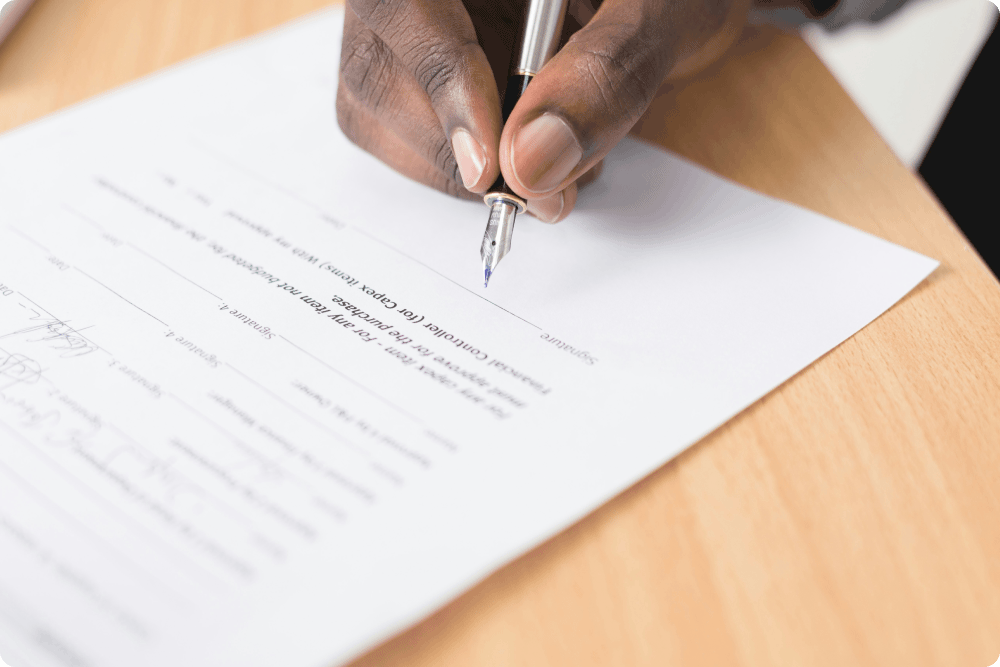
Before a contract can be breached, a valid contract has to exist in the first place. Under UK law, a valid contract, whether written or verbal, requires four key elements:
- Offer: One party proposes specific terms. (e.g., "I will paint your living room for £500")
- Acceptance: The other party agrees to those exact terms without changes. (e.g., "Yes, that sounds good, you're hired")
- Consideration: Something of value is exchanged – usually money (e.g., £500 is exchanged for the painting service)
- Intention to create legal relations: Both parties must intend for the agreement to be legally binding. In commercial and consumer transactions, this is almost always assumed.
What counts as a breach of contract?
In simple terms, a breach of contract occurs when one party fails to fulfil their obligations under a verbal or written agreement. But breaches can vary in severity and the consequences they cause. The type of breach will affect how the court remedies it, so understanding the differences is important.
Minor breach
The contract was not performed perfectly, but you still received the substantial benefit of what was agreed.
- Example: You hire a decorator to paint a room "Brilliant White," and they use "Off-White" instead. The room is still painted and functional.
- Remedy: You cannot terminate the contract, but you can sue for damages to cover any loss, such as the cost of repainting the room.
Material breach
A significant breach of a key term of the contract, but it may not necessarily undermine the entire agreement.
- Example: You order a new car with a leather interior, and it is delivered with a fabric interior. This is a significant deviation from the agreed terms.
- Remedy: You are entitled to claim damages and, in some circumstances, may have the right to terminate the contract.
Fundamental breach (or repudiatory breach)
The failure is so critical that it deprives you of the whole benefit you were intended to get from the contract.
- Example: A builder accepts a £10,000 deposit for a loft conversion and then never shows up to start the work.
- Remedy: You can choose to terminate the contract immediately, be released from your own obligations (e.g., making further payments), and sue for compensation/damages (e.g. returning the deposit).
Anticipatory breach
Words or actions that indicate a party will not perform their contractual obligations ahead of time.
- Example: A month before your wedding, the venue calls to inform you they have double-booked and are cancelling your reservation.
- Remedy: You do not have to wait until the wedding date passes. You can immediately treat the contract as terminated and sue for damages to cover your losses.
What does UK law say about breach of contract?
The law on breach of contract isn't found in one single rulebook. Instead, it's a combination of long-standing principles from "common law" (decisions made by judges over centuries) and specific Acts of Parliament that provide crucial protections for both consumers and businesses.
These include the Consumer Rights Act 2015 for individuals dealing with businesses and the Sale of Goods Act 1979 and the Supply of Goods and Services Act 1982 for agreements made between businesses. Knowing which laws apply to your specific situation and how to use them effectively is where professional legal guidance becomes essential.
Need legal advice on a breach of contract?
What evidence should I gather to prove breach of contract?
Evidence is key to winning your case – it proves the contract existed, defines its terms, demonstrates how the other party failed, and justifies the losses you have suffered. Use this checklist to gather and organise everything.
The agreement itself
This establishes the "promise" that was broken.
- Written contracts: Locate the signed, final version of any formal document.
- Digital communications: Compile all emails, text messages, WhatsApp conversations, or social media messages that discuss the terms.
- Quotes and proposals: Find the initial quote or proposal you accepted. This often includes key terms such as price, scope of work, and timelines.
- Verbal agreements: If the contract was verbal, immediately write down everything you remember about the conversation. Note the date, time, location, and who was present.
Proof of your actions
This shows you held up your end of the bargain.
- Proof of payment: Gather bank statements, credit card receipts, or email confirmations showing you paid deposits, instalments, or the full amount as agreed.
- Actions you took: If you were required to do something (e.g., prepare a room for a decorator), note down when and how you did it.
Proof of the breach
This is the evidence that shows the other party's failure.
- Photographic/video evidence: Take clear, well-lit photos and videos from multiple angles. Include a date stamp if possible.
- Expert reports: For complex issues such as structural defects, you may need a report from an independent expert (e.g., a surveyor or mechanic) that details the problems.
- Failed deliveries: Save any delivery notifications that show an item was not delivered on time or at all.
Proof of attempts to resolve
This demonstrates that you have acted reasonably.
- Communications: Keep a detailed log of every phone call, meeting, and email. Note the date, the person you spoke to, and a summary of the discussion.
- Correspondence: Keep copies of any letters or emails you have already sent regarding the problem.
How do I calculate my financial losses?
When a contract is breached, the goal of the legal system is not to punish the other party but to compensate you for your losses. This requires a careful and justifiable calculation of what the breach has actually cost you – every pound you claim must be linked to a specific, provable loss. Make sure you keep quotes, invoices, or receipts for any costs you intend to claim.
How to respond to a breach of contract
Once you have your evidence organised, the next step is to formally notify the other party of the breach and give them a chance to put things right. This is often called a "Letter Before Action" or "Letter of Claim."
We’d recommend that you seek legal advice at this point. Complex Law can help you draft a well-structured letter that may resolve the situation without the need for further action – but which lays the groundwork for potential legal proceedings should they be required.
The key elements are:
- A heading that states the purpose clearly
E.g. “Letter Before Action”
- A clear introduction, stating who you are and the contract you are referring to
E.g. I am writing in reference to the agreement made on January 1, 2026, for you to supply and install a new bathroom at 123 London Road.
- A summary of the key terms of the contract (agreed work, price, deadline, etc.)
E.g. We agreed that I would pay £1,000 and you would complete all work on the bathroom by January 31 2026
- Details of exactly how the contract has been breached
E.g., It is now February 28, 4 weeks past the deadline agreed in the contract, and the work remains incomplete. The installed shower unit, as documented in the attached photographs, leaks from the base.
- Your required remedy: what you want them to do to resolve the matter
E.g., I need you to provide a reasonable timeline to complete the work and fix the leaking shower base.
- Once you have your evidence organised, the next step is to formally notify the other party of the breach and give them a chance to put things right. This is often called a "Letter Before Action" or "Letter of Claim." to respond and comply.
E.g. I require a full response to this letter within 14 days of the date of this letter. Should you fail to provide a satisfactory resolution by this date, I will have no alternative but to commence legal proceedings to recover my losses without further notice.
Always send this letter via a method that gives you proof of delivery, such as Royal Mail Signed For or an email with a read receipt, or have it sent by your solicitors.
Quick Quiz
How much do you know about romance scams?
Quiz: Question 1 of
5
Quiz Complete
You scored X out of
5





.svg)