Section 8 possession claims: what landlords and tenants need to know
.webp)
Summary
In this article, property law expert David Whelan explains how Section 8 possession claims work for both landlords and tenants, covers the grounds for possession most commonly relied upon, and sets out the practical steps each side should take to protect their position.
Since the abolition of Section 21 "no-fault" evictions on 1 May 2026, Section 8 of the Housing Act 1988 is now the only legal route for landlords in England seeking to regain possession of a rented property. This is a significant shift for the sector – landlords must now identify and prove specific grounds for possession, while tenants have greater certainty that they can't be asked to leave without a stated reason.
At Complex Law, we offer straightforward advice and representation in Section 8 cases for both landlords and tenants, ensuring your rights are protected at every stage. In this article, we explain what each party needs to know about the legislation and the process.
What is a Section 8 notice?
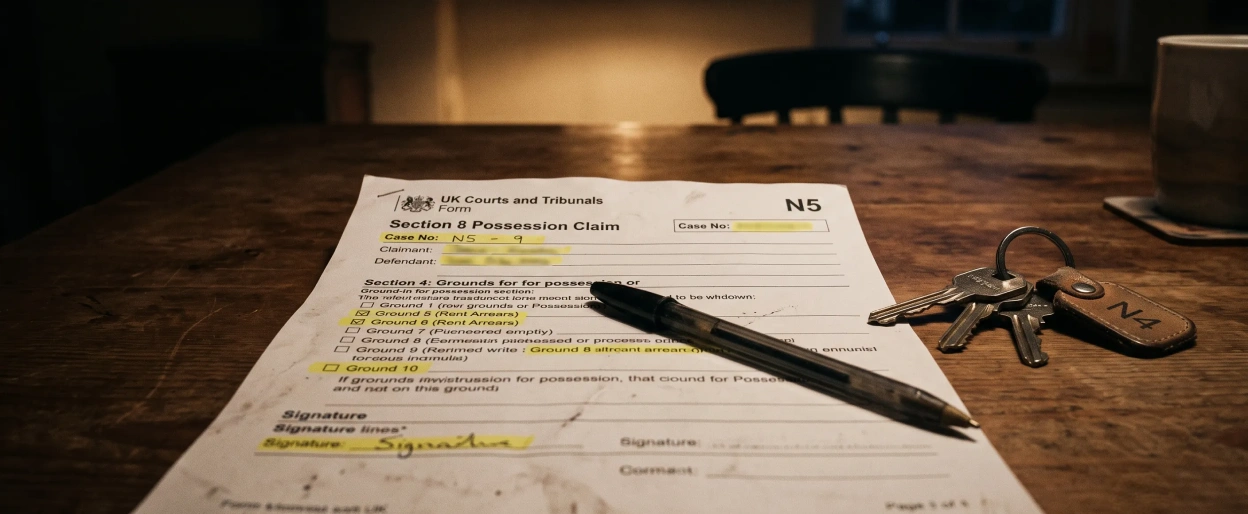
A Section 8 Notice is the official name for the document that a landlord uses to regain possession of a property they own from a tenant. It’s a legal document that sets out the reason or reasons (officially called “grounds”) the landlord believes entitle them to possession of the property, and the evidence that supports their case. To be valid, a Section 8 notice must use the correct prescribed form, state the grounds accurately and fully, and give the tenant the correct minimum notice period – which varies depending on the ground being used.
If the tenant doesn’t act to resolve the issue – for example paying off rent arrears – or vacate the property voluntarily by the time the notice period expires, then the landlord can seek a court order compelling the tenant to leave.
What grounds can a landlord rely on?
The possible grounds for possession under Section 8 are laid out in the government’s Guidance for landlords and letting agents and are split into two categories:
Mandatory grounds
Mandatory grounds are those which – if the landlord can prove that they apply – the court must grant the landlord possession of the property. The most common example of a mandatory ground is Ground 8, which applies to cases where a tenant has rent arrears of three months or more on the date the notice was served and the outstanding rent remains unpaid at the date of the hearing.
Not all mandatory grounds are related to tenant conduct. For example, Ground 1A is used when a landlord wishes to gain possession of a property in order to sell it. However, in these cases notice periods are usually longer (4 months in the case of Ground 1A) and restrictions apply, such as not using this ground during the first year of a tenancy.
Discretionary grounds
Discretionary grounds are slightly different. Even if the landlord can prove that a discretionary ground applies to their situation, the court still has discretion over whether or not to grant possession. Courts will consider the circumstances surrounding the case, as well as the evidence, to inform their ruling.
Common examples of discretionary grounds are Ground 10 (some rent arrears, but below the Ground 8 threshold), Ground 11 (persistent late payment of rent, regardless of arrears at the date of hearing), Ground 12 (breach of another term of the tenancy agreement), Ground 13 (deterioration of the property caused by the tenant), and Ground 14 (nuisance, annoyance, or use of the property for illegal or immoral purposes).
What should landlords do before serving a Section 8 notice?
Serving an invalid notice resets the entire process, causing delays and wasted resources, so before serving a Section 8 notice, it's important that landlords carefully check the following:
Is the ground genuinely made out?
Gather evidence that supports the ground or grounds you intend to use: depending on the specifics of the case, this could include rent statements, emails or messages between you and the tenant, photographs or videos of damage or nuisance, or witness accounts.
Is the correct form being used?
Section 8 notices must be served using the prescribed form (usually Form 3), and errors on the form can invalidate the notice entirely.
Is the notice period correct?
Depending on the ground, notice periods can range from a matter of days to several months. Using the wrong period is one of the most common (and most costly) mistakes we see.
Are you compliant elsewhere?
If the tenancy deposit hasn't been protected correctly, or prescribed information hasn't been served, this can prevent the court from granting possession, even where the underlying ground is proven.
What should tenants do if they receive a Section 8 notice?
The most important thing is not to panic or ignore the notice. Receiving a Section 8 notice is stressful, but it doesn’t mean you have to leave the property immediately, and often there are ways to challenge the notice or resolve the situation without being evicted from your home.
Check the notice is valid
Errors in the form, incorrect grounds, or an incorrect notice period can all mean that a Section 8 notice is invalid – and holds no legal weight. If you’re not sure what to look for, seek legal advice for Section 8 notices from a specialist firm such as Complex Law.
Address the underlying issue if possible
If the notice relates to rent arrears, making payments (even partial ones) can strengthen your position, particularly on discretionary grounds.
Gather your own evidence
If you have a potential defence – for example, unresolved disrepair, or a dispute over the amount of arrears claimed – start collecting correspondence, photographs, and records now.
Don't ignore court paperwork
If the landlord issues proceedings, you'll receive a claim form and should complete and return the defence form by the deadline given, even if you're unsure of your position.
What happens if the case goes to court?
If the tenant hasn't resolved the issue or vacated once the notice period expires, the landlord can issue a claim for possession in the County Court. The court will consider whether the notice was validly served, whether the ground is proven, and any defence raised by the tenant.
Possible outcomes include:
- An outright possession order – the tenant must vacate the property, usually within 14 days (though this can be extended in certain circumstances).
- A suspended or conditional possession order – the tenant can remain in the property provided they comply with specific terms, such as a repayment plan for arrears.
- Dismissal of the claim – if the landlord cannot prove the ground, or the notice was defective.
Frequently asked questions
I'm a landlord. My tenant owes two months' rent. Can I use Ground 8?
No – since 1 May 2026, Ground 8 requires at least three months of rent arrears at the time the notice is served. There are discretionary grounds which apply when arrears are less than three months’ rent: Ground 10 or Ground 11. Speak to Complex Law, and we'll advise on the best approach based on the specifics of your situation.
I've received a Section 8 notice, but I don't think the arrears figure is correct. What should I do?
The first thing to do is review your own records: payment receipts or bank statements showing the date and amount of any transactions relating to rent payments. If your figures show that you’re not in arrears, or that the amount of rent owed is different to that claimed in the notice, then you may be able to challenge the validity of the notice. Court deadlines in possession claims can be short though, so seek legal advice as soon as possible.
Can a landlord evict a tenant for one missed payment?
No, generally one missed rent payment isn’t grounds for eviction. A single missed payment doesn’t meet the three-month threshold for Ground 8, and as far as discretionary grounds are concerned, a court is unlikely to grant possession for minor arrears, especially if there’s no persistent pattern of missed payments.
My tenant has been causing a nuisance to neighbours. What are my options?
Nuisance or annoyance would usually fall under Ground 14, which is a discretionary ground, although one that can be served with immediate effect if the underlying issues are serious. To prove Ground 14, you’ll need evidence such as witness statements, incident logs, or reports from neighbours or the local authority. If you’re not sure whether your situation and evidence meet the standard to serve a Section 8 notice relying on Ground 14, speak to our expert property law team, and we’ll advise you on the best approach.



.svg)